


"It Will Save Me Taking the Generator" — Steven Palmer's eBike Gold Prospecting Adventure, Solar Charging in Outback Western Australia
Updated: Jun 14
Real Rider Story · Trial 1 · Western Australia · solarebikecover.com
When Steven Palmer packed up his camp gear and headed to Starvation Bay, Western Australia, he wasn't sure what to expect with from the Solar eBike Cover strapped to his kit. A gold prospector who rides eBikes through outback Australia to reach remote detecting sites, Steven had always relied on a generator to keep his batteries alive. Ten days later, he came back with a verdict that said everything:
"The solar unit performed beyond expectations."
This is his story.
Starvation Bay — Ten Days of eBike Gold Prospecting Off the Grid
Starvation Bay is the kind of place that doesn't appear on tourist maps. Remote coastal Western Australia, where the beach meets the sand dunes and the scrub stretches as far as you can see. No powered sites. No infrastructure. No power points.
It's exactly the kind of place Steven Palmer loves — and exactly the kind of place where charging an eBike has always been a problem.
Steven is a gold prospector. He rides eBikes to reach remote detecting sites across outback WA — places where you can't pedal through the heavy scrub, so the throttle does all the work. That drains batteries fast.
For years, the solution was a generator. Heavy, noisy, expensive to run. A necessary evil for anyone wanting to ride electric in the outback.
Then he agreed to trial the Solar eBike Cover.
The Conditions — Sand, Dunes and Hard Work
If you wanted to design a worst-case test for an eBike battery, Starvation Bay would be a strong contender.
Steven and his wife were riding 7 to 10 kilometres a day — but not on smooth paths or sealed roads. Every kilometre was completely off-road. Along the beach. Through sand dunes. On rough tracks.
"In many cases pushing the bikes using the throttle to help through the sand. Even when riding, 50% was throttle because of the heavy soft sand. Bloody hard work sometimes but fun."
Soft sand is one of the most demanding surfaces for an eBike battery. The motor works constantly, drawing power even at low speeds. After each ride, Steven's bike control panel was showing at least one battery panel down — sometimes two.
These were not easy conditions. They were exactly the conditions that make off-grid charging essential.
The Solar eBike Cover in Action
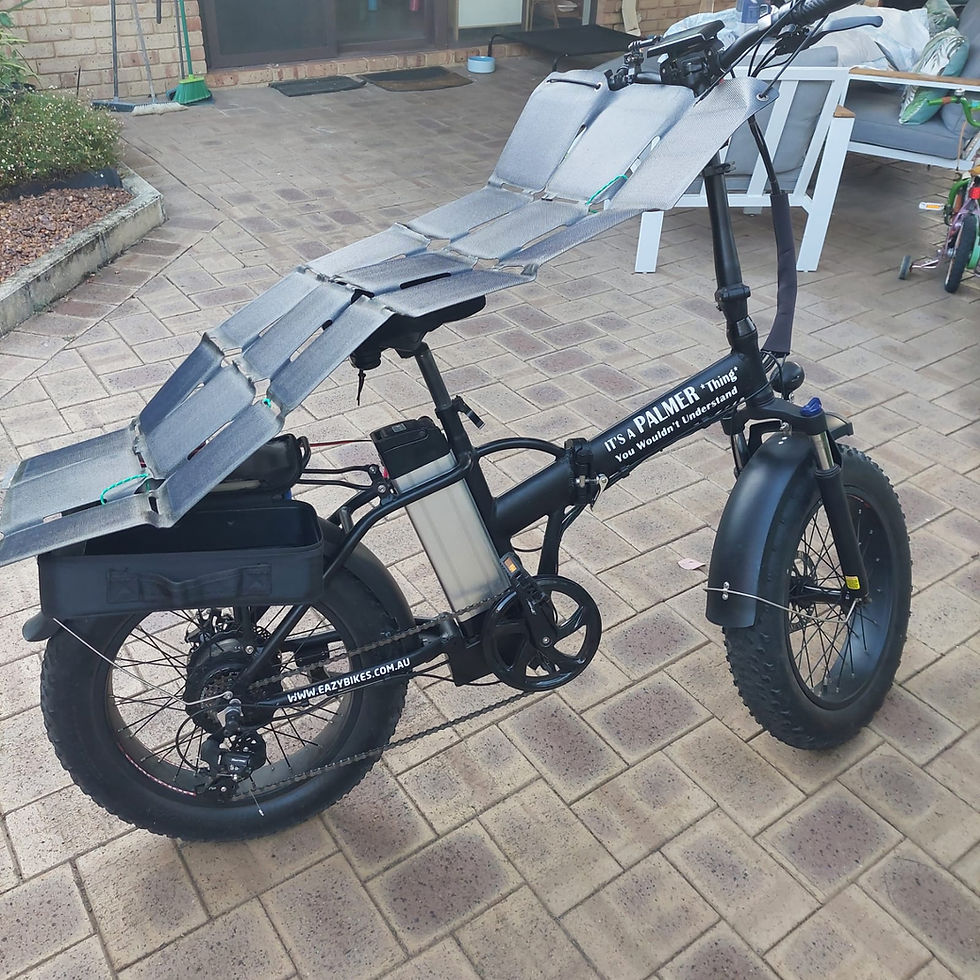
Steven's routine was straightforward. He'd ride out to his prospecting site, set up the Solar eBike Cover alongside the bike, then get to work detecting. While he swept the ground, the sun did the charging.
The bike charged at the site — not back at camp. By the time he was done for the day, the battery was topped up and he could ride back to camp without the mental arithmetic of whether he had enough range left.
The results were consistent: around two hours of charging at the site was enough to bring both bikes back to full capacity, ready for the next day's adventure.
"Charged both bikes for about 2 hours or so and ready for next ride."
Two bikes. Completely off-grid. No generator. Just the Western Australian sun.
Multiple Rides in a Day — The Top-Up Philosophy in Practice
One of the most interesting insights from Steven's report is how naturally the Solar eBike Cover fits into a multiple-ride day.
"On a number of occasions I went for 2 or 3 rides during the day on my own. Upon completion charged the bike as a top up — worked well. Quick because only topping up."
This is the top-up philosophy that the Solar eBike Cover is designed around. Rather than waiting for a battery to run flat and then fully recharging, you top up between activities — keeping the battery in the optimal 20–80% range. Each top-up is faster than a full charge, and the solar panel does the work while you're having lunch, detecting, or simply enjoying the view.
Even on Overcast Days
One of the most common questions about solar eBike charging is: what happens when it's cloudy?

Steven answered this from the field:
"It was even overcast on a couple of days — still managed to charge."
The Solar eBike Cover uses high-efficiency SunPower silicon cells with a built-in MPPT (Maximum Power Point Tracking) controller [1] that optimises output even in diffuse light conditions. Overcast skies reduce output — but they don't stop charging. In most Australian conditions, there's enough diffuse solar energy to keep the charging process going.
Honest Feedback — Two Things to Improve
Steven is a practical man, and his report included honest feedback on two areas for improvement — exactly the kind of input that makes a trial program valuable.
Setup angle: The unit sits slightly awkwardly when the bike is on its kickstand, because most bikes lean when parked. This is a geometry challenge the team noted for future refinements.
Cable length: Steven and his wife ride different bikes — a Rambler Fat Tyre and a Husky — with handlebar heights that differ by about 150mm. This created slack in the panels on one bike. Getting the distance between the unit and the handlebars right is important for a neat, efficient setup.
This revealed something important for anyone considering the Solar eBike Cover across multiple bikes: the unit is sized for a specific handlebar-to-rear-rack distance range. If you plan to share the Solar eBike Cover between bikes with significantly different dimensions, it's worth checking compatibility first — the fit that's perfect for one bike may not be ideal for another.
For most riders using it on a single bike, this is not an issue. But Steven's experience taught us to be upfront about it — which is why we now ask all Trial 2 applicants to measure their handlebar-to-rear-rack distance before we dispatch their unit.
Both are real, useful observations. Neither stopped the unit from performing brilliantly — but both informed improvements in the Trial 2 design.
"It Will Save Me Taking the Generator"

After ten days at Starvation Bay, Steven summed up his experience in one line that has stayed with us:
"As I will be using it in the WA outback where I would ride through the bush, stop/start detecting for gold — probably no more than 6 to 7 kilometres per day — it will save me taking the generator."
That's 6 to 7 km of detecting — not counting the ride out and the ride back. Add multiple sessions in a day and the real daily distance is significantly more, all of it off-road, all of it on throttle.
That single sentence captures everything the Solar eBike Cover is designed to do.
For a gold prospector riding through remote WA scrub — where you can't pedal, the throttle runs constantly, and the nearest power point is hours away — eliminating the generator changes everything.
No fuel to carry. No noise scaring away wildlife. No heavy equipment to haul in and out of the bush.
Just the sun, the bike, and the open outback.
What Steven's Trip Proved
Steven's ten days at Starvation Bay validated the Solar eBike Cover in conditions that most eBike riders will never encounter.
He proved it works in sand — one of the hardest surfaces for battery drain, where throttle use is constant and range is reduced significantly.
He proved it works for two bikes — not just one. Two different brands, two different battery sizes, charged from the same unit. His honest feedback on the sizing difference between his Rambler Fat Tyre and his wife's Husky also gave us critical data on the importance of matching the unit to bike dimensions — something we now check with every Trial 2 applicant before dispatch.
He proved the top-up approach works — multiple rides per day, quick top-ups between outings, no need to wait for a full charge.
He proved it works on overcast days — not just in blazing sunshine.
And he proved what we always believed: that for Australian riders who venture into remote country, solar charging isn't a gimmick. It's a genuine solution to a real problem.
Steven's Next Adventure
Steven's planned next adventure with the Solar eBike Cover is the WA goldfields — his real hunting ground, and exactly where his quote points.
Multiple sessions a day through dense scrub — riding out to the site, detecting, riding back, then heading out again. Riding purely on throttle through terrain that would stop a pedal bike cold. Remote locations where no generator means no charging — and no charging means a much shorter day.
If his Starvation Bay experience is anything to go by, the generator stays home.
We can't wait to hear how it goes.
Try It Yourself
Steven was one of three Australian riders who tested the Trial 1 version of the Solar eBike Cover. Based on their feedback — including his detailed Starvation Bay report — we developed the improved Trial 2 version, now delivering 175–235W via AC output, compatible with every eBike brand.
Trial 2 is currently open for 4 Australian eBike riders. Read Ken Lew's eTrike discovery and [Robert Hunter's Victorian High Country story] to see what our other Trial 1 riders found.
If you ride an eBike in remote or off-grid conditions — whether you're prospecting, camping, hunting, fishing or simply exploring the Australian outback — we'd love to hear from you.
👉 Apply at solev.com.au 👉 Full product details at solarebikecover.com
Steven Palmer · Gold Prospector · The Vines, WA · Trial 1 Rider
The Solar eBike Cover is designed in Australia by SOLEV. 🇦🇺
References
[1] MPPT (Maximum Power Point Tracking) controller technology — optimises solar panel output in variable light conditions. SunPower solar cell technology — sunpower.com


Comments