


"The Panels Protect the eBike from the Sun" — Ken Lew's eTrike Solar Charging Discovery in Australia
Real Rider Stories · SOLEV · solarebikecover.com

Most eBike riders don't think too hard about their charger. You come home, you plug in, you go to bed. The charging happens somewhere between the wall socket and the battery, and that's about as much attention as it gets.
Ken Lew thinks differently.
Ken Lew rides an eTrike in Seaford, South Australia. He was one of three Australian riders who tested the first Solar eBike Cover during Trial 1 — a DC output prototype designed to answer one question: does solar charging actually work in the real Australian field?
It did. But Ken also found something nobody had designed for — something that stopped him mid-ride and made him reach for his phone.
"The panels protect the eBike from the sun. That's a big plus, as I always cover my bike."
That single observation changed how we think about the Solar eBike Cover. Not just as a charger — but as a cover.
Ken's Setup — Seaford SA
Ken rides a Vamos e-Trike. Three wheels, a step-through frame, and the kind of stability that makes an eTrike the right choice for riders who want confidence and comfort on every ride — not just the flat, easy ones.
Like a lot of South Australian eTrike riders, Ken keeps his bike outdoors. The South Australian sun is relentless. Leaving an eBike battery exposed to full summer sun isn't just uncomfortable — it's hard on the battery. Lithium cells don't like sustained heat, and in Australian conditions that heat can shorten battery life significantly [1] — something we cover in detail in [How to keep your eBike battery healthy for longer]. Ken knows this, which is why he always covered his bike.
What he didn't expect was for the Solar eBike Cover to take care of that problem automatically.
Charging at 1.5 Amps — The Patient Approach
Ken's charging routine with the Trial 1 DC unit was methodical and deliberate.
His Vamos e-trike runs a 52V 20Ah battery with close to 100 km of real-world range — solid for a heavyweight machine that demands more power than a typical eBike. That's why his system charged at 1.5 amps, a gentle rate that takes 16 hours or more to fully charge from empty. That's not a flaw. That's sound battery management.
"The charging rate of mine at 1.5 amps is a safe charging rate. Faster can damage batteries, shorten life, or cause fires. At 1.5 amps to charge my batteries is about 16+ hours. So what you're saying is correct — as you're out and stopping, plug it in as much as possible."
Ken had immediately understood the top-up philosophy without being prompted. He didn't think of the Solar eBike Cover as a device to charge a flat battery in one session. He thought of it as something you plug in whenever you stop — at a coffee shop, during lunch, at a rest stop — and let it quietly add range while you get on with your day.
That's exactly the right way to use it. Ken rides to the beach regularly for a swim — the Solar eBike Cover goes on while he's in the water, and the bike is charging while he is. By the time he's dried off, he has more range than when he arrived. No planning. No detour to find a power point. Just park, deploy, swim.
The Sun Cover Discovery

Here's the observation that changed things.
South Australian summers are fierce. Battery manufacturers are clear: sustained heat exposure degrades lithium cells faster than almost anything else. Ken had always covered his eTrike when parked — a habit born from experience, not instruction.
When the Solar eBike Cover went on, it solved the charging problem and the heat problem simultaneously.
"The panels protect the eBike from the sun. That's a big plus, as I always cover my bike."
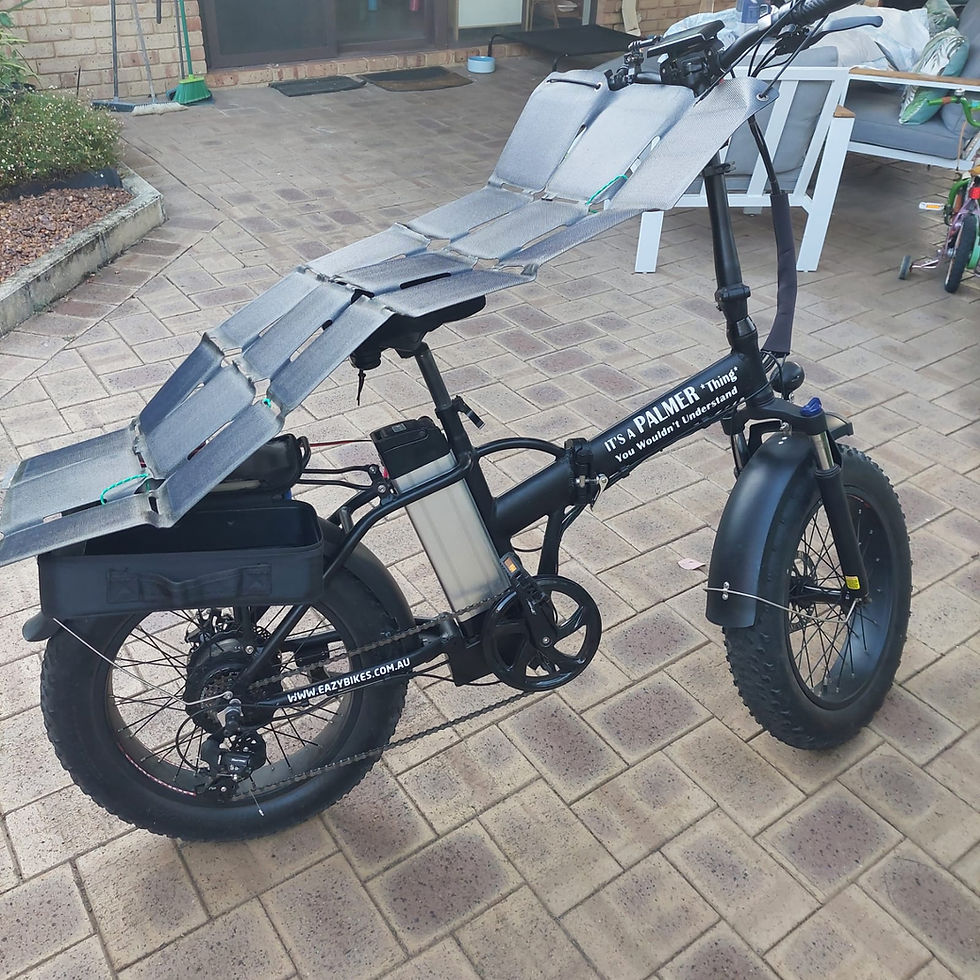
Nobody designed the Solar eBike Cover to be a sun shield. The panels are there to face the sky and harvest light. But when deployed over a parked eTrike in the South Australian sun, they shade the bike beneath them — keeping the battery cooler, slowing heat-related degradation, and protecting the paintwork and components from the harshest UV exposure.
Ken spotted it immediately because he was already thinking about battery protection. A rider who'd never considered the heat problem might have missed it entirely.
We didn't miss it. This finding went straight into how we talk about the product — and into what we test in Trial 2.
Working in Overcast Conditions
One of the most common questions people ask about solar eBike charging is the one Ken asked directly:
"And say it was still working on rainy days and protection for the trike from rain. I'll still do one on a sunny day. But people still need to know that sun doesn't need to be shining for solar panels to work. It's the light, isn't it?"

The answer, as Ken correctly intuited, is solar irradiance — the intensity of light energy reaching the panel — not direct sunshine specifically. Overcast days block most irradiance but not all. Panels continue to generate power in diffuse light. Less power, yes — but not zero.
The Trial 1 DC system Ken used has a genuine advantage here: DC charging works even at low irradiance, with no minimum activation threshold. Ken confirmed this from his own experience:
"It is still working strong. As stated it still charges while overcast."
We want to be honest about Trial 2, because Ken specifically asked us to be. The AC output system doesn't work as well in overcast conditions — it needs a minimum input level to activate the charger, which DC doesn't. On a heavily overcast day, a Trial 2 unit may not charge where a Trial 1 unit still would.
That's a real difference, and it's worth saying plainly.
To address this, Trial 2 units include a small backup battery. Its job is twofold: it stabilises the power output to the charger, and it carries the system through brief overcast patches — cloud shadows, passing cover — keeping the charging session running rather than dropping in and out. For typical Australian overcast conditions, this works well. For sustained heavy overcast across a full day, the honest answer remains: plan a grid top-up as backup.
The full story of why we made the switch — and what it means for riders in different conditions — is in [From Trial 1 to Trial 2 — why we changed from DC to AC].
Coffee Stops, Lunch Breaks and Range Confidence

Ken's description of how he uses the cover in daily life is the best single-sentence summary of the top-up philosophy anyone has offered us:
"Using frequently at various coffee stops or lunch breaks stops the battery concerns to get back home or to base camp."
That's it. That's the product in one sentence.
Range anxiety — the background hum of worry that accompanies eBike riders on longer trips — doesn't disappear when you have a bigger battery. It disappears when you know charge is accumulating every time you stop. The battery isn't counting down. It's counting up.
Ken also noted something that experienced users of any tool discover: repetition builds confidence and speed.
"Add — the more one uses it the quicker it becomes to set up."
The numbers back this up. In Ken's video, filmed during his trial, he unfolds the system in about 20 seconds. In a separate video filmed by the SOLEV founder, the full unfold demonstration took under 10 seconds. Same product. Different point on the learning curve.
The Solar eBike Cover folds and unfolds in about 10 seconds — and as Ken found, it doesn't take long to get there.
Does It Work on Different eBikes?

Ken also rides an Ampd Bros Ace-S Pro eBike — a separate bike from his Vamos e-trike. He was getting a plug fitted for the Ace-S Pro at the time, and asked the question that matters to any rider with more than one electric bike in the garage:
"Should the same unit work on different eBikes? If so, I'll be able to just snap into the wire connection. That will be a plus sales point."
This is the real-world multi-bike household. Ken wasn't asking hypothetically — he had an eTrike and two eBike, and he wanted to know whether one Solar eBike Cover could serve both.
The Trial 1 DC unit required a compatible connector for each bike. The AC output version launching in Trial 2 changes this entirely — by connecting through the bike's original charger, it works with every eBike, eTrike, eCargo and eMoto brand via standard AC output. One unit. Any bike. No adaptors.
Ken identified this as a sales point before we'd framed it as one. He was right — and it became one of the clearest reasons to move to AC output for Trial 2. The full story is in [From Trial 1 to Trial 2 — why we changed from DC to AC].
Ken's Verdict
Ken's final summary, offered as a direct quote for SOLEV to use:
"You can quote me that it does everything a 240 volt charger does and everything I would have expected."
From a rider who came in with practical, measured expectations — who charges at 1.5 amps, always covers his bike, and thinks carefully about battery health — that's a considered endorsement.
"The presentation case is first class."
The unit did what it was supposed to do. In South Australian conditions. On an eTrike. With a cautious, knowledgeable rider who would have noticed if it didn't.
What Ken's Trial Taught Us
Ken's feedback added three things to the product story that we hadn't fully articulated before:
1. The sun cover function is real and valuable.
It wasn't designed in — but it belongs in the product description. Battery heat protection matters in Australia, and the Solar eBike Cover delivers it passively.
2. The top-up philosophy works in practice.
Ken validated it independently, without being coached on it. Plug in at stops. Don't wait for empty. Let range confidence accumulate the same way the charge does.
3. Multi-bike compatibility is a genuine priority.
The question Ken raised — will this work on my other bike? — is the question that drove the move to AC output in Trial 2.
What's Next
Trial 2 is underway with four new Australian riders testing the AC output version of the Solar eBike Cover — 175–235W of SunPower cells, universal compatibility via your own charger, and the same folding form factor that Ken described as "first class."
If you ride an eBike, eTrike, eCargo, or electric motorcycle in Australia and you'd like to be part of what comes next:
👉 Apply at solev.com.au
👉 Full product details at solarebikecover.com
🇦🇺 Australian owned & designed · As seen at Eurobike 2025 · Patent pending
References
[1] Xinming Fan et al. "Temperature effect and thermal impact in lithium-ion batteries: A review." Progress in Natural Science: Materials International, 2018. sciencedirect.com/science/article/pii/S1002007118307536
[2] Vamos Bikes — Australia's premium electric bikes and e-trikes. vamosbikes.com.au
[3] Ampd Bros ACE-S PRO Step Through Dual Suspension Fat Tyre Electric Bike. ampdbros.com.au/products/ace-s-pro-dual-suspension-electric-bike
[4] Bureau of Meteorology — Average daily solar exposure maps, Australia. bom.gov.au/climate/maps/averages/solar-exposure


Comments