


Solar eBike Cover Trial 1 to Trial 2 — What Changed and Why We Switched from DC to AC Charging
Technology & Innovation · SOLEV · solarebikecover.com
---

Every great product is shaped by the people who use it first.
Trial 1 gave us three Australian riders — a hunter, an eTrike rider and a gold prospector — who took our first Solar eBike Cover into the real world and came back with honest, detailed feedback that changed everything.
This is the story of what Trial 1 taught us, why we made the switch from DC to AC charging, and what Trial 2 riders are getting — and what to expect.
---
Trial 1 — The Concept Proved in the Field
Trial 1 was about one question: does the concept actually work?
Three Australian riders. Three completely different use cases. Three very different environments.
Robert Hunter — a hunter from Rocky Camp SA — tested it in remote South Australian bush. His first report back: "Plugged the charger in before opening the panels and it's working perfectly."
Ken Lew — an eTrike rider from Seaford SA — discovered something we hadn't even anticipated. "The panels protect the eBike from the sun. That's a big plus." The Solar eBike Cover wasn't just a charger — it was a sun shield too.
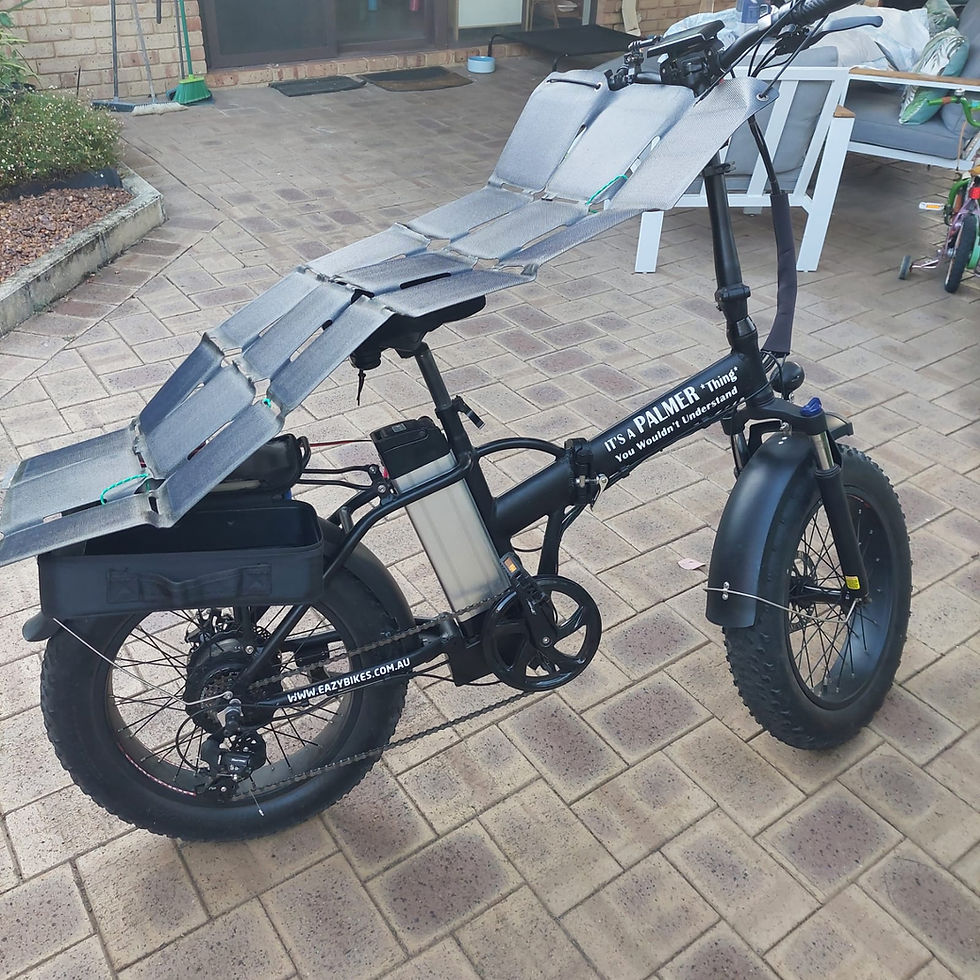
Steven Palmer — a gold prospector from The Vines WA — put it through ten gruelling days at Starvation Bay, charging two bikes completely off-grid through sand dunes, rough coastal tracks and even overcast days. His verdict: "It will save me taking the generator."
The concept worked. Unambiguously. In real Australian conditions, with real riders, in genuinely remote locations.
But Trial 1 also taught us three important things that needed to change.
---
What Trial 1 Taught Us
1. The kickstand angle problem
When a bike sits on its kickstand, it leans. The Solar eBike Cover panels need to face the sun at a reasonable angle to charge efficiently. Steven flagged this from Starvation Bay — the lean created a less-than-ideal panel angle.
2. Bike sizing — a consideration for multiple bikes
The Solar eBike Cover is sized for a specific handlebar-to-rear-rack distance. Steven's two bikes — a Rambler Fat Tyre and a Husky — differed by about 150mm, creating slack in the panels on one bike. It works perfectly on a single bike within the compatible size range, but sharing across bikes with significantly different dimensions needs consideration. More on this in Steven's full story.
3. The charging interface problem — plugs, BMS and compatibility
Trial 1 used DC output with our smart universal charger that auto-detects voltage and charging rate — no manual matching needed. But even with auto-detection, DC charging still needs to negotiate with each battery's BMS and physically connect via the correct plug type. Our three Trial 1 riders each encountered this in different ways — a BMS that silently rejected the DC output, plug variations across different eBikes, and connector configuration differences. The eBike market's enormous variety of charger and plug configurations made building a truly universal DC solution extraordinarily complex and costly — a challenge that would only grow as more brands entered the market. This is what drove the switch to AC. Full details in each rider's story.
---
The DC vs AC Decision — Why We Made the Switch
This is the most important technical change between Trial 1 and Trial 2 — and it's worth explaining properly, because it's a decision that affects every rider who uses the product.

Trial 1 used DC output.
Direct current charging is technically more efficient. Power goes from the solar panel directly into the battery with minimal conversion losses — typically 92–97% end-to-end efficiency. In a controlled, matched system, DC is the right choice.
But as explained above, the charger and plug complexity across eBike brands made building a truly universal DC solution extraordinarily complex and costly.
The solution was elegant: instead of trying to match every battery's connector and protocol, power the eBike's own charger instead.
Every eBike already comes with a charger. That charger is designed specifically for that battery. It knows the exact voltage. It speaks the exact protocol. It's already approved by the manufacturer.
By switching to AC output — the same standard power that comes out of your wall socket — the Solar eBike Cover powers any eBike's own charger. The charger does what it was designed to do. The Solar eBike Cover simply replaces the wall socket.
The result:
Universal compatibility with every eBike, eTrike, eCargo, eMoped and eMoto brand — forever
No adaptors needed
No modifications to the bike
Manufacturer warranty unaffected
Works with every future eBike brand too
And why the higher output was necessary:
AC charging introduces a real power conversion loss — typically 20–30% through the charger — compared to DC's direct panel-to-battery efficiency. To compensate for this loss and still deliver meaningful charging performance, we needed to significantly increase panel output. This is why Trial 2 moved from 90–120W to 175–235W — as a bonus, but also a necessity to make AC charging viable in real-world conditions.
The trade-off is real but the gain is clear — universal compatibility with every eBike brand on the planet, via the charger the rider already owns. No adaptors. No matching. No modifications. Just plug in and charge.
DC charging is not inferior — it is genuinely more efficient in matched systems, and performs better in low-irradiance and overcast conditions. But for a product that needs to work with every eBike on the planet, AC output was the right engineering decision. Universal compatibility won over raw efficiency.
---
What Trial 2 Riders Are Getting
Based on Trial 1 feedback, here is what the Trial 2 version delivers:
Higher output:
175–235W of Sunpower silicon cells — up from 90–120W in Trial 1. The higher panel output is designed to deliver meaningful charging performance in real Australian conditions.
AC output — universal compatibility:
Works with every eBike brand via your own charger. Bosch, Shimano, Bafang, Yamaha, and any other brand — if it has a standard AC charger, the Solar eBike Cover works with it.
10-second folding mechanism:
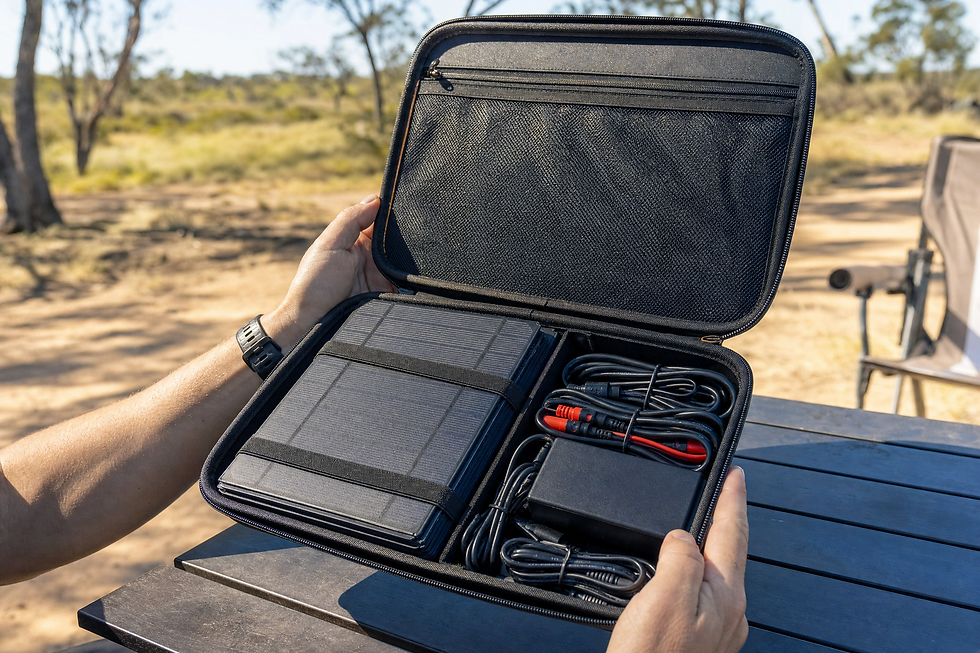
The bi-directional accordion fold has been refined based on Trial 1 rider feedback. The panel stack compresses to 21×29cm — shoebox sized — in about 10 seconds.
All in one carry case:
The carry case holds everything — the panel unit, all electronics and cables, and even your eBike charger. One case, nothing left behind.
---
What to Expect as a Trial 2 Rider
If you've been selected for Trial 2 — or are hoping to be — here's what the experience looks like:
Setup:
Unfold the Solar eBike Cover in about 10 seconds. Position over your bike. Connect your own eBike charger between the unit's AC output and your battery. Done.
Charging time:
Depends on battery size, state of charge and solar conditions. For a typical 500Wh eBike battery at 50% charge — expect 2–4 hours in full Australian sun. Partial charges (top-ups) are significantly faster.
Best practice — the top-up approach:
Don't wait for a flat battery. Top up whenever you stop in the sun — it's better for your battery health and means you're always ready for the next ride. We cover this in detail in our post on eBike battery health tips.
Overcast periods:
Trial 2 units include a small backup battery that serves two purposes: it stabilises the power output from the solar panels for a smoother, more consistent charge, and it sustains power continuity during brief overcast periods, bridging the gap until the sun returns. Plan your charging sessions around sunny conditions for best results.
What we're asking from Trial 2 riders:
Ride with it in your normal conditions
Note charging times and battery levels before and after
Share photos and short videos where possible
Send honest feedback — what worked, what didn't, what surprised you
A short written or voice note at the end of the trial
Your feedback will directly shape the production version. The same way Trial 1 riders shaped Trial 2, Trial 2 riders will shape what every future customer receives.
---
What Comes Next
Trial 2 is the final step before production.
When four Australian riders bring their Solar eBike Covers back from the bush, the beach, the goldfields and the trails — with real data, real photos and real feedback — we'll have everything we need to build the production version.
And then the Solar eBike Cover goes on sale to every Australian eBike rider who's ever been frustrated by the lack of charging infrastructure in this country.
Which, as it turns out, is quite a few people.
---
Apply for Trial 2
Trial 2 is currently open for 4 Australian eBike riders.
If you ride an eBike, eTrike, eCargo, eMoped or electric motorcycle in Australia — and you've ever wished you could charge away from a power point — we'd love to hear from you.
👉 Apply at solev.com.au
👉 Full product details at solarebikecover.com
🇦🇺 Australian owned & designed · As seen at Eurobike 2025 · Patent pending
---
References & Further Reading
No external references for this post — all content is based on SOLEV's own Trial 1 and Trial 2 experience and technical decisions.


Comments