


DC Solar eBike Charging Isn't Forgotten — Here's Why It's Still on the Table
Technology & Innovation · solarebikecover.com
When SOLEV switched from DC to AC output for Trial 2, we were careful to say one thing clearly: DC is not inferior. We chose AC for compatibility — not because DC was the wrong technology.
That distinction matters. Because DC solar charging is still on the table, and for a growing category of electric vehicles, it's already the right answer today.
This post is for riders who've been following the DC→AC story and want to know what comes next.

Why DC Is the More Efficient Approach
Start with the physics. DC solar charging delivers power directly from the panel to the battery via an MPPT (Maximum Power Point Tracking) controller [1]. The conversion path is short: solar energy in, battery energy out. End-to-end efficiency runs at 92–97%.
AC output takes a different route. The solar panel generates DC, which is converted to AC to feed the charger, which converts it back to DC to charge the battery. Two conversions instead of one. Each conversion has losses.
In full Australian sun, the difference is measurable. In low irradiance — overcast days, early mornings, deep shade — DC has another advantage: it has no minimum activation threshold. AC needs enough input to power the charger before any charging begins. DC starts working from the first photon.
Our Trial 1 riders — Steven, Robert, and Ken — all used DC units. Ken confirmed it from the field: "It is still working strong. As stated it still charges while overcast." That's DC doing what DC does best.
What DC Couldn't Do — The CAN-Bus Barrier
So why switch?
The eBike market moved. Modern eBikes from Bosch, Shimano, Specialized, and most major brands post-2019 use CAN-bus protocols — a digital handshake between battery and charger that controls the entire charging process. A DC source that doesn't speak that protocol can't initiate charging safely.
DC also requires matching the battery's voltage and communication protocol — manageable on the simpler battery systems used in Trial 1, but increasingly complex as the eBike market has moved toward sophisticated battery management systems.
AC output sidesteps all of this. By feeding the rider's original charger, which already speaks the battery's language, SOLEV's AC output works with every eBike brand without exception. Universal compatibility was worth the efficiency trade-off.
That decision is covered in full in [From Trial 1 to Trial 2 — why we changed from DC to AC].
Where DC Is Already the Right Answer — Today
Here's the part that changes the narrative.
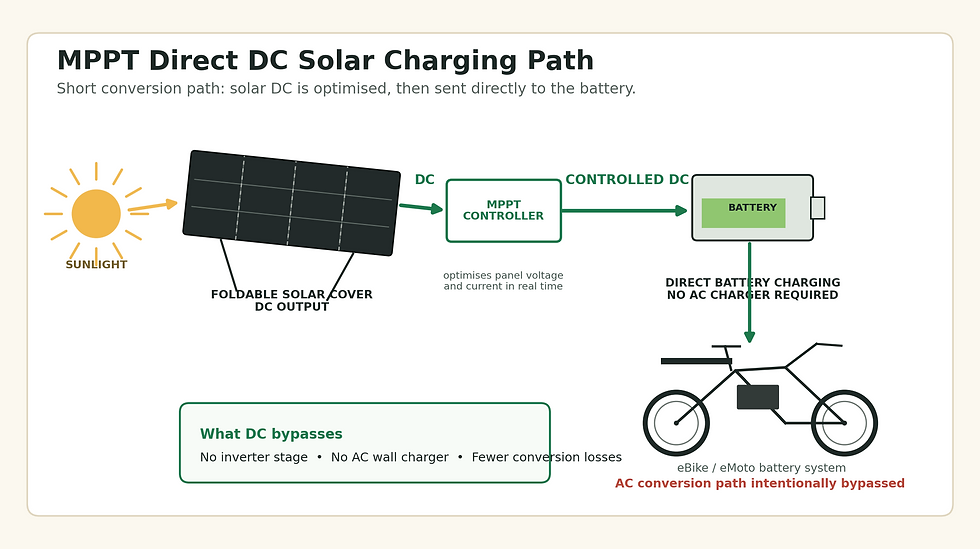
The original framing was: DC will return when the market is ready. What we didn't say clearly enough is this — for a specific and growing category of electric vehicle, DC is already the right answer right now.
High-powered electric motorcycles and utility eMotos use chargers that draw 400–600W or more from the mains. SOLEV's 175–235W AC output can't power a charger of that size. It simply doesn't have enough capacity.
DC direct to the battery bypasses the charger entirely. SOLEV connects via MPPT controller and delivers 175–235W at full solar capacity, regardless of what the original charger's rated input is. For an eMoto rider in remote terrain — where there's no grid, no generator, and potentially no original charger at a forward base — DC solar is the only viable charging method.
This isn't a future use case. It's today's problem for a real and growing class of electric vehicle. It's why DC output remains in active development at SOLEV — not as a legacy product, but as the right tool for a different class of vehicle.
The Field Has Already Validated the Concept
Solar charging for electric bikes in field operations isn't theoretical. Military testing of electric bikes has already included the use of solar panels for charging in the field [2] — folding panels that connect directly to the battery, bypassing external charging infrastructure entirely.
The concept works. The question is always output, form factor, and reliability. SOLEV's bi-directional accordion fold delivers 175–235W in a compact, purpose-engineered package — a significant step forward from the flat-fold panels currently in field use.
We mention this not as a product announcement, but as context: when there is no charging infrastructure, DC solar direct to the battery is how electric vehicles stay operational. That principle scales from a remote hunting camp in the Victorian High Country to anywhere a power point doesn't exist.
The Open Standards Future
There's a longer arc here too. The eBike market is moving — slowly but clearly — toward more open charging standards.
In 2025, Ampler Bikes launched the first eBike with integrated USB-C Power Delivery charging, winning a Eurobike Award for it [3]. USB-C PD 3.1 now supports up to 240W at 48V — enough for most commuter-level eBike chargers [4]. Orbea launched its RS system in September 2025, integrating all electronic components into a common ecosystem [5].
These are early signals, not a completed transition. As BikeRadar put it in early 2026: eBikes should all use this one common charger cable — and the conversation is gaining momentum.
When the market moves toward open standards — whether USB-C, a common DC protocol, or something not yet defined — the CAN-bus compatibility barrier that pushed SOLEV to AC disappears. DC output returns: higher efficiency, better low-light performance, maximum energy from every hour of sun.
SOLEV is watching the market. When DC becomes broadly viable across the consumer eBike segment, we'll be ready.
What This Means for Riders Right Now
If your eBike uses a Bosch, Shimano, Specialized, or any major brand battery post-2019: AC output is the right choice right now. Compatible, safe, warranty-preserving. Trial 2 is confirming this with real riders across Australia.
If you ride a high-powered eMoto or electric motorcycle: AC output may not be able to power your charger. DC is the correct solution for your vehicle class. Get in touch — we're developing DC output for exactly this application.
Either way: the solar concept works. The output type is an engineering detail, not a barrier. The sun doesn't care which conversion path you use.
The Honest Roadmap
AC today: universal compatibility, works on every eBike brand, Trial 2 is validating this now
DC in development: for eMoto and high-powered electric vehicles where AC output is insufficient
DC for consumer eBikes: when open charging standards make it broadly viable — higher efficiency, better low-light performance, maximum solar yield
This is SOLEV's honest roadmap. Not a marketing timeline. Not a launch announcement. Just where the technology is, where it's going, and why.
Follow our journey at solev.com.au — or read [From Trial 1 to Trial 2] for the full DC→AC story.
🇦🇺 Australian owned & designed · As seen at Eurobike 2025 · Patent pending
References
[1] MPPT (Maximum Power Point Tracking) controller technology — optimises DC solar output for direct battery charging. SunPower solar cell technology — sunpower.com
[2] Military solar eBike charging field testing — CleanTechnica, "Where Are the Military E-Bikes?" January 2022 — cleantechnica.com/2022/01/31/where-are-the-military-e-bikes/
[3] Ampler Bikes USB-C PD eBike charging — Eurobike Award 2025 — bikerumor.com/ampler-bikes-new-curt-minimalistic-ebike-uses-first-on-bike-usb-c-charging-system/
[4] USB-C PD 3.1 — up to 240W at 48V for eBike charging — electrek.co/2025/10/27/the-number-of-e-bikes-with-usb-c-charging-has-now-doubled-to-two/
[5] Orbea RS system — integrated eBike electronics ecosystem, September 2025 — bikeradar.com/features/opinion/ebikes-should-all-use-usb-c


Comments