


eBike Camping in Australia — How Solar Charging Let You Go Further, Stay Longer, and Never Worry About Range
eBike Adventure & Lifestyle · solarebikecover.com
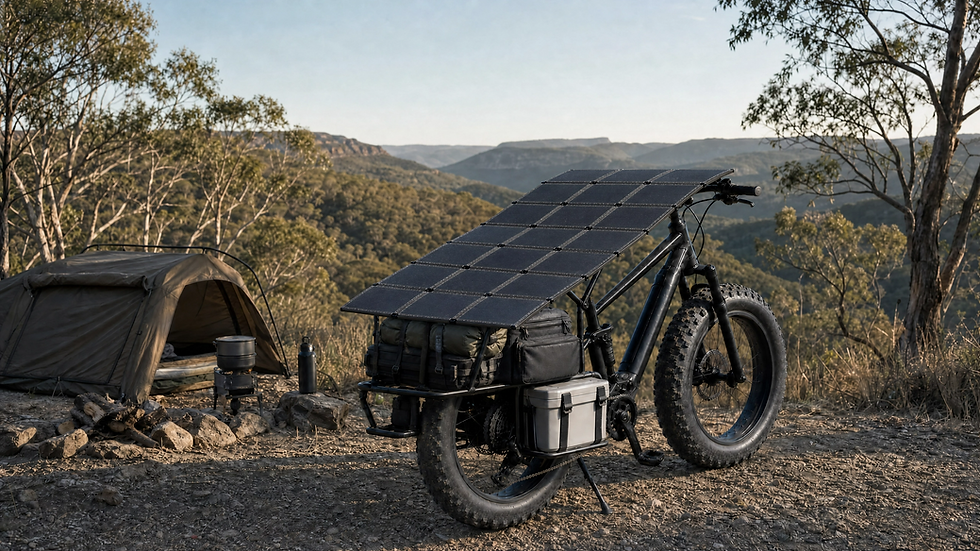
eBike camping in Australia is entering its best era. The bikes are more capable, the routes are better documented, and the combination of electric assist and a loaded camping setup is changing what's possible for riders who want to go further than a day ride allows.
But the battery question hasn't gone away. In fact, it gets harder on multi-day trips. You can charge at a pub or a campground with power — if there is one. You can carry a portable power station — if you don't mind the weight. Or you can take a different approach entirely: charge while you ride, charge while you camp, and stop managing range altogether.
This is how solar eBike charging changes the camping equation.
Why eBikes Are Becoming the Bikepacking Bike of Choice
Electric bikes are fast becoming the bikepacking bike of choice for multi-day camping trips [1]. The reason is simple: motor assist means you can carry more without suffering more.
A loaded bikepacking setup — tent, sleeping bag, food, water, cooking gear — adds 20–40kg to your ride. On a regular bike, that weight transforms every climb from a challenge into a test of character. On an eBike, the motor compensates. You still feel the weight; you just don't fight it the same way.
For Australian terrain specifically — long distances between towns, significant elevation changes in the alpine and high country zones, unpredictable weather in the south — the eBike's ability to manage effort across a full multi-day trip is genuinely valuable.
Electric bikes make camping accessible to riders who might struggle with traditional bike camping — motor assist reduces physical barriers while allowing you to carry the gear that makes a multi-day trip comfortable rather than survival-mode.
The Charging Problem — and the Solar Solution
Here's where eBike camping in Australia gets complicated.
Campgrounds with power: Available at many national park sites and caravan parks, but not all. Wild camping — the kind that gets you away from the crowds — rarely has power access. And even when power is available, you're tethered to a spot while the bike charges.
Portable power station: Works well at base camp. Heavy to carry — a 1,000Wh unit weighs 8–12kg. You charge it at home, use it in the field, and when it's gone, it's gone.
Grid charging in towns: Works for routes that pass through towns regularly. Becomes limiting on remote routes where towns are 100km apart.
Solar charging: Charges continuously during the day — while you ride, while you stop, while you camp. No weight penalty beyond the cover itself. No dependence on campground power. No end to the energy supply as long as the sun is up.
The Solar eBike Cover deploys over the handlebar and rear rack in about 10 seconds. At a lunch stop, a rest break, or a full campsite setup, the panels go to work automatically. By the time you're ready to move, the battery has more charge than when you arrived.
How Solar Changes the Multi-Day Equation
On a typical eBike camping day in Australian conditions — 60–80km of mixed terrain, some climbing, loaded bike — battery management is a constant mental task. How far to the next charge point? How much have I used? Can I push further or should I conserve?
Solar charging removes that calculation from the equation.
Deploy the cover at every stop. Lunch: 30–45 minutes of charging adds range back to the battery. Camp setup: an hour in the afternoon sun tops up significantly. Overnight? The morning sun starts working before you break camp.
The [top-up philosophy] that works for day rides works even better on multi-day trips — because you have more stops, more time stationary, and more sunlight hours to work with. The battery never gets as low as it would on a pure grid-charging approach, because it's constantly being replenished.
Robert Hunter — one of SOLEV's Trial 1 riders — tested exactly this approach. [He camps for days in the Victorian High Country] with dual batteries and no power access. The Solar eBike Cover deployed at camp meant both batteries charged while he was on foot — and the bike was ready to go when he returned.
Australian eBike Camping Routes Worth Exploring

Victorian High Country — The network of fire trails, alpine tracks, and hut-to-hut routes in Victoria's northeast are some of Australia's best eBike camping terrain. The Ride High Country Gravel Network alone covers 2,170km across 50+ routes for all levels [5]. The Murray to Mountains Rail Trail and Great Victorian Rail Trail offer gentler options alongside more technical backcountry. Power access is minimal — solar is the practical charging solution. Plan routes at victoriashighcountry.com.au/ride
Brisbane Valley Rail Trail (QLD) — A gentler introduction to multi-day eBike touring. The trail passes through small towns, and purpose-built eBike-friendly accommodation has emerged along the route [2]. Good for first-time eBike campers with a mix of grid charging and solar top-ups.
Munda Biddi Trail (WA) [7] — At 1,060km from Mundaring (near Perth) to Albany on the south coast, the Munda Biddi is one of the world's longest continuous off-road cycling trails [6]. Twelve purpose-built campsites with sleeping shelters and rainwater tanks are spaced roughly a day's ride apart — no tent required for sections between huts. Remote stretches with no towns make solar charging a practical asset between resupply points. Full maps and the official trail app at mundabiddi.org.au
Snowy Mountains (NSW/ACT) — The trails around Kosciuszko and the high plains offer excellent summer eBike camping with genuine alpine character. The solar charging window is long in summer — 5+ peak sun hours per day even at altitude.
Grampians (VIC) — Technical terrain, stunning scenery, and a mix of campgrounds with and without power. Fat tyre eBikes handle the rocky tracks; solar handles the charging gaps.
Gear List — eBike Camping with Solar Charging
The eBike setup:
eBike suited to your terrain — fat tyres for sand and loose trails · eMTB for technical terrain · standard eBike for gravel and sealed tracks
Rear rack — essential for panniers and the Solar eBike Cover
Front rack or handlebar bag — balances the load
Battery sized for your longest day — solar charging top-ups throughout the trip reduce range anxiety, but capacity still matters for the longest legs between stops
Camping gear (eBike advantage — you can carry more):
Lightweight tent — 3-season minimum for alpine areas
Sleeping bag appropriate for conditions — don't skimp in the mountains
Compact stove and fuel
Water filter — for remote sections without treated water
PLB (Personal Locator Beacon) — essential for remote Australian terrain [3]
Charging setup:
Solar eBike Cover — primary charging during stops and camp
Original eBike charger — for campground power when available
Small power bank — for phone and GPS charging overnight
Planning Your Route Around Solar Charging
A few practical considerations for multi-day solar eBike camping:
Ride north-facing slopes in the morning, south-facing in the afternoon — On multi-day routes, you can orient rest stops to maximise solar exposure. On an Australian south-facing slope in winter, irradiance is noticeably lower than on a north-facing aspect.
Plan longer stops in the middle of the day — Peak solar hours in Australia are 10am–2pm. A lunch break timed to that window does more charging work than an early morning stop of the same length.
Don't skip the stop — The temptation on a good riding day is to push through. Solar charging rewards the rider who stops — every 30-minute rest stop in full sun adds meaningful range. On a loaded multi-day trip, that discipline pays off by the third day.
Check the BOM forecast before remote sections — Extended cloud cover in a remote section with no grid access is the scenario to plan for. A portable power bank or a campground charge before a known overcast stretch is sensible preparation. BOM also publishes historical climate data by region [5] — useful for trip planning weeks ahead, so you know what sun to expect on a particular route in a particular month before you leave home.
The eBike Camping Mindset Shift
Traditional bikepacking culture is built around ultralight minimalism — strip the kit to nothing, suffer the climbs, embrace the grind. eBike camping offers a different philosophy.
Unlike conventional bikepacking that emphasizes ultralight minimalism, electric bike camping allows for enhanced comfort and safety gear, making multi-day wilderness expeditions accessible to a broader range of outdoor enthusiasts [4].
You can carry the tent that's actually comfortable. The sleeping bag that's actually warm enough. The food that's actually good. The camera that makes the trip worth photographing.
And with solar charging, you can go further between towns, spend longer at the spots worth staying at, and come back having ridden somewhere genuinely remote — rather than somewhere close enough to a charger.
That's the eBike camping proposition. Not a compromise on adventure. An expansion of it.
Try It for Yourself
Trial 2 of the Solar eBike Cover is now open for Australian riders. If you camp on your eBike — or you're planning to — the Solar eBike Cover is the charging solution designed for exactly the terrain and conditions you ride in.
👉 Apply at solev.com.au 👉 Full product details at solarebikecover.com
🇦🇺 Australian owned & designed · As seen at Eurobike 2025 · Patent pending
References
[1] eBikes as bikepacking bikes of choice — electricbikesbrisbane.com.au/blogs/ebike-rides-tours/bikepacking-by-e-bike-5-day-mt-warning-camping-trip
[
[2] Brisbane Valley Rail Trail eBike-friendly accommodation — ambmag.com.au/feature/how-to-go-e-bikepacking/
[3] PLB for remote Australian riding — Emergency Management Australia recommendation for remote area travel
[4] eBike camping comfort advantage — tamobykesport.com/blogs/blog/e-bike-camping-adventures-gear-and-route-planning-with-tamobyke
[5] Bureau of Meteorology — historical climate data and solar exposure by region — bom.gov.au/climate/data/
[6] Ride High Country Gravel Network — 2,170km across 50+ routes — victoriashighcountry.com.au/ride
[7] Munda Biddi Trail — 1,060km Mundaring to Albany, official maps and trail app — mundabiddi.org.au


Comments