


How to Charge Your eBike Completely Off Grid — Every Option Explained
Practical How-To · solarebikecover.com
The question comes up every time someone takes an eBike beyond the city fringe: how do I charge this thing when there's no power point for kilometres?

It's a fair question — and the answer has more options than most riders realise. Some are heavy and inconvenient. Some are clever but expensive. And one is increasingly the obvious choice for Australian riders who venture into genuine remote terrain.
This guide covers every practical method for off-grid eBike charging, what each one is actually like to use, and how to decide which fits your riding.
Option 1 — The Generator
The generator is the traditional answer. Petrol-powered, heavy, loud, and effective. If you're carrying gear in a 4WD, a small generator can charge an eBike overnight without any problem. eBike chargers typically draw around 100–200W of continuous wattage, so almost any generator with a standard AC outlet will work.
Pros:
Works regardless of weather or cloud cover
Can charge multiple devices simultaneously
Widely available and familiar
Full charge capacity — no dependence on conditions
Cons:
Heavy to carry — a significant logistical burden for remote trips
Loud — a serious problem in national parks, quiet campsites, or any location where noise matters
Runs on petrol — fuel must be carried, stored, and managed safely in the bush
Expensive to run per kilowatt-hour
Emissions — incompatible with leave-no-trace riding
Increasingly regulated — and in some regions, being phased out entirely
That last point is worth noting. California (AB-1346, signed 2021) has already banned the sale of new small petrol generators under 25 horsepower in two phases — stricter emissions standards from 2024, and full zero-emission requirements from 2028 [1]. While Australia hasn't followed yet, the direction of travel globally is clear: small petrol generators are a technology under pressure.
Steven Palmer — a gold prospector from The Vines WA who rode eBikes to remote detecting sites in outback WA — had been relying on a generator for years. After trialling the Solar eBike Cover, his verdict was simple: "It will save me taking the generator." Not because the generator doesn't work. Because there's now a better option.
Option 2 — Portable Power Station
A portable power station is a large rechargeable battery pack with AC outlets, USB ports, and DC outputs built in. You charge it at home or via solar panels, then use it in the field as a silent, fuelless power source.
Pros:
Silent — no noise, no emissions
Versatile — charges phones, cameras, lights, and eBike chargers from one unit
Can be topped up via solar panels during the day
No fuel required in the field
Works in any weather
Cons:
Heavy — a 1,000Wh unit typically weighs 8–12kg, workable in a vehicle but impractical on a bike
Finite capacity — a full charge from flat takes time and requires a power source (grid or solar)
Expensive upfront — quality units run $500–$1,500 AUD
Charging time — topping up a large eBike battery (e.g. 52V 20Ah = 1,040Wh) from a 1,000Wh station leaves little reserve
For riders who drive to a trailhead and set up a base camp, a portable power station is an excellent solution — especially paired with a roof-mounted or portable solar panel. For riders who want to charge in situ at their actual stop, it's less practical.
Option 3 — Car Inverter
If you're driving to your ride location, your car battery is already a sizeable energy source. A DC-to-AC inverter plugged into the 12V outlet — or directly to the battery terminals — converts car power to standard AC, enough to run an eBike charger.
Pros:
Minimal weight — the inverter itself is small and light
No additional fuel required beyond what's in the car
Simple to set up — plug in, connect charger, done
Works overnight at camp
Cons:
Requires the car to be present — not useful mid-ride
Risk of flattening the 12V car battery if the engine isn't running
Slow charging for larger eBike batteries without running the engine periodically
Not a standalone solution — dependent on vehicle access
Best suited for riders who drive to a trailhead, ride out and back, and charge overnight at the vehicle. Not useful for multi-day trips away from the car.
Option 4 — In-Situ Solar Charging
This is where the approach shifts fundamentally.
In-situ solar charging means the panel charges your eBike where you actually stop — not back at camp, not back at the car. At the prospecting site. At the fishing spot. At the hunting camp. Wherever the ride takes you.
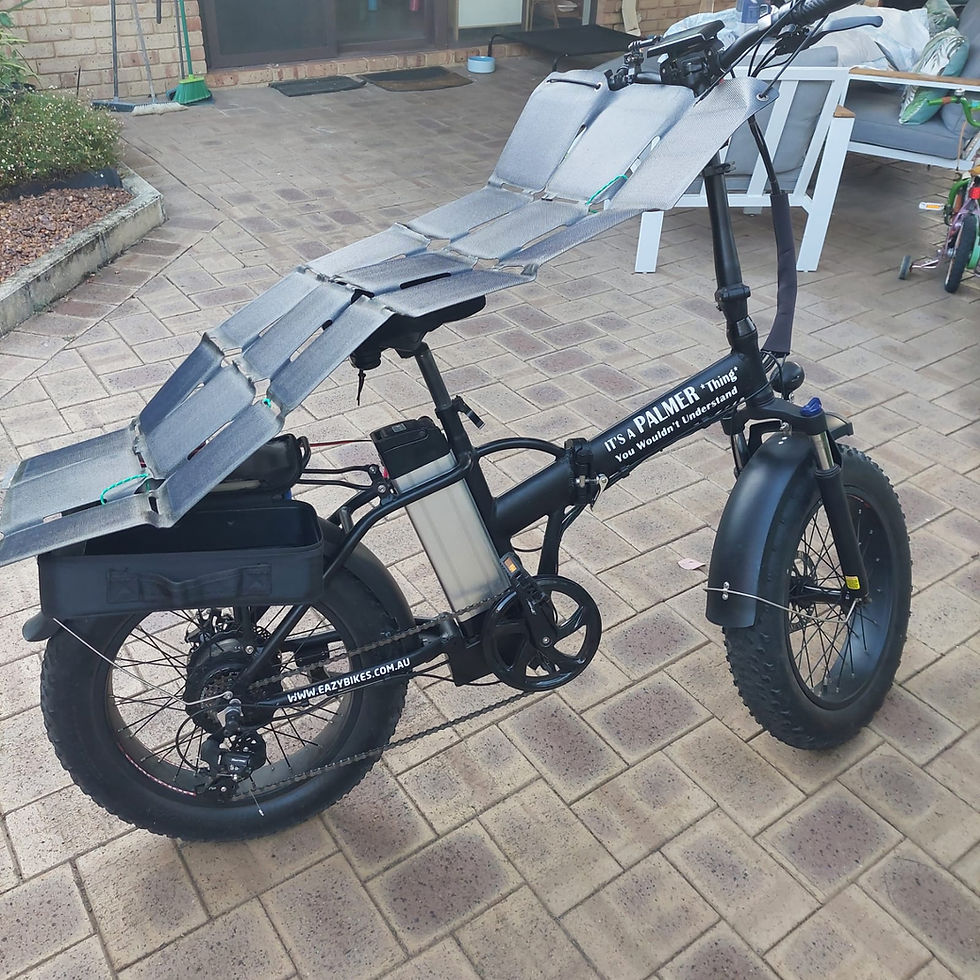
The Solar eBike Cover deploys over the handlebar and rear rack in about 10 seconds [2], connecting through your bike's original charger via AC output. While you're doing whatever you came to do, the sun does the charging.
Pros:
Lightest option — folds to a compact carry case, no fuel, no heavy battery required
Truly in-situ — charges at your stop, not at base camp
Silent and zero emissions
Works with every eBike brand via your original charger
Passive income of range — every stop adds kilometres back
Panels shade and protect the battery from heat — a bonus discovered by our Trial 1 riders
Cons:
Requires sun — heavily overcast days reduce output significantly
Generates less power per session than a generator or large power station
Works best with the top-up philosophy rather than a full charge from empty
That last point is important — and it's actually a strength reframed. In-situ solar charging isn't designed to replace a full overnight charge. It's designed to work with the [top-up philosophy]: charge little and often, keep the battery in the 20–80% range, and never ride to empty in the first place.
The riders who get the most from solar charging aren't the ones who wait until they're flat and then try to fill up. They're the ones who top up at every stop — at the prospecting site, at the lunch break, at the lookout — and ride with a battery that's always comfortably above empty. More range, less planning, and no generator to lug in and out of the bush.
Of course, the sun is required. For most of Australia, receiving 4–6 peak sun hours per day [3], that's not a significant constraint. For consistently overcast conditions, plan a grid top-up as backup.
Comparing the Options
Method | Weight | Fuel | In-situ | Noise | Regulations |
Generator | Heavy | Petrol | No | Loud | Increasingly restricted |
Portable power station | Medium–heavy | None (charges at home/solar) | Possible | Silent | None |
Car inverter | Minimal | Car fuel | Your Car | Yes, from the Engine | None |
In-situ solar (SEBC) | Light | None | Yes ✅ | Silent | None |
What Most Australian Riders Actually Need
If you drive to a trailhead and ride from there: A portable power station at base camp, topped up by a roof or portable solar panel, is clean and reliable. Charge it on the drive or overnight at camp.
If you ride into remote terrain with your gear: In-situ solar is the practical choice. The Solar eBike Cover goes on the bike, charges where you stop, and adds no meaningful weight to your kit.
If you already have a generator: It works — but if you're looking for a reason to leave it behind, in-situ solar is that reason.
If you're on a multi-day eBike tour: Combination charging — top up via the Solar eBike Cover during stops, supplement with a small power station overnight — gives maximum flexibility with minimum weight.
The Direction of Travel
Globally, the off-grid charging landscape is shifting. California's ban on new small petrol generators from 2028 is the clearest signal yet [1] — portable petrol generators are a technology being actively regulated out of existence in progressive markets.
Solar is not just a lifestyle choice anymore. For riders who venture beyond the grid — in Australia and increasingly everywhere else — it's becoming the obvious answer.
Try It for Yourself
The Solar eBike Cover is now in Trial 2 with Australian riders. If you ride an eBike in remote or off-grid conditions, the waitlist is open.
👉 Apply at solev.com.au 👉 Full product details at solarebikecover.com
🇦🇺 Australian owned & designed · As seen at Eurobike 2025 · Patent pending
References
[1] California AB-1346 — ban on new small petrol generators under 25hp. Phase 1: stricter emissions from 2024. Phase 2: zero-emission requirement from 2028. California Air Resources Board — ww2.arb.ca.gov/resources/documents/california-state-emergency-january-7-2025-sale-offer-sale-and-importation-u-s
[2] Solar eBike Cover setup time — about 10 seconds to fold/unfold; setup in about 30 seconds
[3] Bureau of Meteorology — Average daily solar exposure maps, Australia. bom.gov.au/climate/maps/averages/solar-exposure/
[4] Portable power station eBike charging guide — iallpowers.com/blogs/blog/can-a-portable-power-station-charge-an-electric-bike


Comments