


Why Australia Is the Perfect Country for Off Grid eBike Solar Charging
Solar eBike Charging · solarebikecover.com
If you were designing the ideal country for solar eBike charging from scratch, you'd start with three things: abundant sunshine, a culture built around outdoor adventure, and vast stretches of remote terrain where power points simply don't exist.

Australia has all three — and it's not even close.
This isn't a marketing claim. It's geography, climate data, and riding culture combined into one remarkable alignment. Here's why solar eBike charging works so well in Australia — and why Australian riders are some of the most natural early adopters of the technology in the world.
Australia Gets More Sun Than Almost Anywhere on Earth
Start with the fundamentals. Solar charging depends on solar irradiance — the intensity of sunlight reaching a panel. The higher the irradiance, the more power the panel generates, and the faster your battery charges.
Australia receives between 1,387 and 2,264 kWh/m² of solar energy per year [1] — some of the highest levels on the planet. In practical terms, that translates to 3.8 to 6.3 peak sun hours per day depending on where you ride. Western Australia leads the country, but even southern states like Victoria and New South Wales deliver strong results.
Compare that to Europe — the birthplace of eBike culture — where peak sun hours average 2 to 4 per day, and where cloud cover is a constant limiting factor. A solar eBike charging system that generates 150W in Germany on a clear day might generate 200W+ under the same sky in South Australia.
The Bureau of Meteorology maps confirm this consistently [2]: even in winter, most of Australia delivers enough daily solar exposure to meaningfully charge an eBike battery during a ride or a stop.

The Terrain Demands Off-Grid Solutions
The second factor is just as important as the first: Australia is enormous, and much of it has no power infrastructure at all.
A gold prospector riding through the WA scrub. A hunter camping for a week in the Victorian High Country. A fisherman launching from a remote coastal access point hours from the nearest town. These aren't edge cases — they're everyday scenarios for Australian eBike riders who venture beyond the city fringe.
In Europe or North America, off-grid riding is a deliberate lifestyle choice. In Australia, it's often simply the terrain. The distances are longer, the towns are smaller and further apart, and the places worth riding to are frequently the places furthest from any electrical outlet.
That's the environment where solar eBike charging shifts from a nice-to-have to a genuine solution. Not a backup. Not a novelty. The primary charging method — because there is no other option.
Australian Riders Already Think This Way
There's a cultural dimension here too. Australian outdoor culture has long valued self-sufficiency. Off-grid camping, 4WD touring, prospecting, hunting, fishing — these are activities built around the idea of being away from infrastructure, not tethered to it.
eBike riders who come from this background already understand the generator problem. They've already made the calculation: the generator is heavy, noisy, expensive to run, and a logistical hassle. They've been looking for a better answer.
In 2024, Australia recorded 4.6 million cycling-inclusive trips worth $6 billion [3]. Seven in ten cycling trips took place outside capital cities — in exactly the regional and remote terrain where off-grid charging matters most. The riders already exist. The terrain already exists. The problem already exists.
Solar eBike charging is the answer that was already being asked for. The [top-up philosophy] — charging little and often rather than waiting for empty — comes naturally to riders who already stop frequently to camp, detect, or fish. Solar automates it.
The eBike Market Is Accelerating Fast
Australia's eBike market reached over $1 billion AUD in 2025 [4] and is growing rapidly. Falling battery costs, improving motor technology, and increasing cycling infrastructure are all driving adoption — and as eBikes become more capable and more common, the range question becomes more pressing.
An eBike rider doing a day ride from the city has grid charging available at both ends. An eBike rider doing a week-long bikepacking route through remote NSW does not. As eBikes move further into adventure riding, touring, and remote use — exactly where Australian terrain takes riders — the need for off-grid charging grows with them.
The Solar eBike Cover was designed for this moment. Not for the rider who plugs in at home every night, but for the rider who goes further.
Real Riders. Real Australian Conditions.

SOLEV's Trial 1 put the Solar eBike Cover in the hands of three Australian riders in exactly the conditions that make off-grid charging essential.
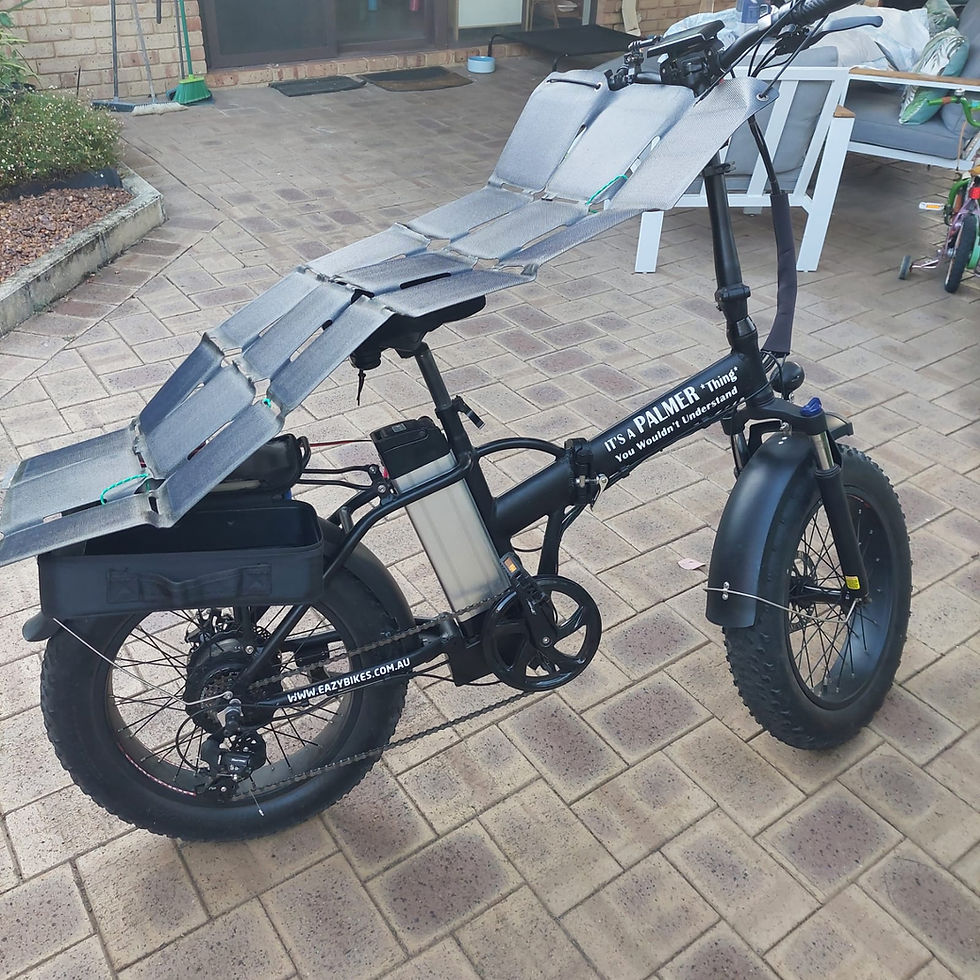
Steven Palmer — a gold prospector from The Vines, WA — took it on a ten-day trip to Starvation Bay. Remote coastal WA, no powered sites, two eBikes charged completely off-grid. His verdict: "It will save me taking the generator."
Robert Hunter — a hunter from Rocky Camp, SA — tested it ahead of a week-long expedition in the Victorian High Country. Dual batteries, 30kg backpack, mountain terrain. No power points. Exactly where the technology earns its place.
Ken Lew — an eTrike rider from Seaford, SA — discovered something nobody expected: the panels shading his battery from the South Australian sun. A cooling benefit that came free with the charging. "The panels protect the eBike from the sun. That's a big plus."
Three riders. Three different use cases. Three different states. All pointing to the same conclusion: Australia is where solar eBike charging makes the most sense.
The Sun Is Already There
The grid costs money to build, maintain, and extend. In remote Australia, the cost of extending it to where riders actually go is so high it simply hasn't happened — and likely never will.
The sun, by contrast, is already everywhere. Every remote track, every beach access point, every prospecting site, every hunting camp in this country receives enough daily solar energy to meaningfully charge an eBike battery. The infrastructure is already in place. It just needs to be captured.
The Solar eBike Cover does exactly that — folding down to a compact carry case, deploying over the bike's handlebars in about 10 seconds, and delivering 175–235W of SunPower solar output wherever the ride takes you.
Australia didn't need to wait for solar eBike charging to be invented. It was already the obvious answer. It just needed the right product.
Ready to Ride Farther?
Trial 2 of the Solar eBike Cover is currently underway with four Australian riders. If you ride an eBike in remote or off-grid conditions — anywhere the grid doesn't reach — the waitlist is open.
👉 Apply at solev.com.au 👉 Full product details at solarebikecover.com
🇦🇺 Australian owned & designed · As seen at Eurobike 2025 · Patent pending
References
[1] Australia average peak sun hours — 1,387–2,264 kWh/m² per year. climatebiz.com/average-peak-sun-hours-australia/
[2] Bureau of Meteorology — Average daily solar exposure maps, Australia. bom.gov.au/climate/maps/averages/solar-exposure/
[3] Tourism Research Australia — Cycling tourism in Australia, 2024. tra.gov.au/en/economic-analysis/cycling-tourism
[4] Australia eBike market revenue 2025. grandviewresearch.com/horizon/outlook/e-bikes-market/australia


Comments