


eBike Fishing in Australia — How to Reach the Spots Nobody Else Can
eBike Adventure & Lifestyle · solarebikecover.com
The best fishing spots in Australia are rarely the easy ones. They're the remote beaches accessible only along kilometres of soft sand. The rock platforms at the end of a track that's too rough for a car. The estuary mouth three kilometres past the last car park. The places most anglers give up on because the walk is too hard, the terrain is too soft, and the gear is too heavy.
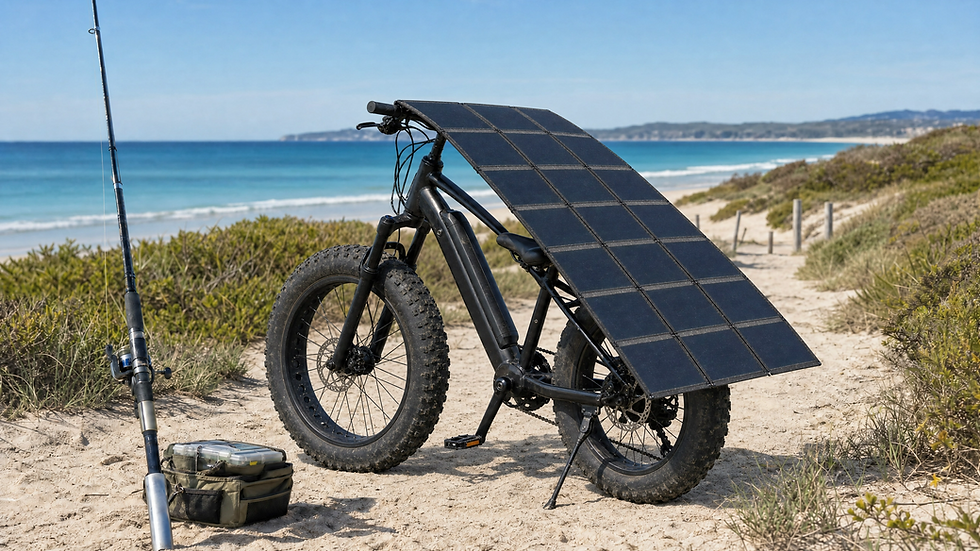
An eBike changes that calculation entirely.
Whether you don't have a 4WD to get to remote access tracks, you're after a quiet afternoon at a spot without the crowds, or the terrain between the car park and the water is simply too rough or too far to walk with full gear — an eBike fits the bill. You don't need to be chasing the world's most remote fishing spot to benefit. You just need to want to get somewhere the average angler doesn't bother.
And when you add solar charging to the mix — charging the bike at the fishing spot while you fish — the equation flips completely. No more managing how far you've ridden. No more cutting sessions short because you're worried about the ride back. Just more time at the water, doing what you came to do.
eBikes and Fishing Are a Natural Match
Anglers often face challenges accessing fishing spots on foot due to weather or darkness. Electric bikes for fishing remove these obstacles, allowing easy access during optimal fishing hours — spending more time fishing and less time commuting, reaching backcountry and remote waters quickly.
The weight capacity matters too. A fishing eBike setup needs to carry rods, a tackle box, bait, water, food, and potentially a cooler for the catch. Fat tyre eBikes with high payload capacity can accommodate rider, fishing rods, tackle boxes, coolers, and catch — with wide fat tyres providing stability on soft sand when carrying heavy loads.
For Australian anglers, the terrain adds another dimension. Coastal beaches, tidal flats, sand dunes, estuary edges — soft surfaces that would stop a regular bike cold are exactly what a fat tyre eBike handles best. The secret to riding on sand is flotation — distributing the combined weight of the rider, the bike, and the gear over a much larger surface area rather than slicing into the surface.
The Range Question — and the Solar Answer
Here's where most eBike fishing conversations stop: range. A fat tyre eBike on soft sand draws significantly more power than the same bike on a sealed path. Motor assists constantly. Progress is slower. Battery drain is real.
A road-legal eBike motor carrying a loaded fishing setup works harder than one on an unloaded commute. Battery drain accelerates with every kilogram of gear. That's not a flaw. It's just physics — and it's exactly the scenario where the [top-up philosophy] earns its place. Small, frequent solar top-ups keep the battery comfortable. You never hit empty because you never let it get there.
For a short beach access — a kilometre or two each way — most eBike batteries handle it fine. But for the serious angler who wants to ride five, ten, or twenty kilometres along a remote beach to find undisturbed water, battery range becomes a genuine constraint.
The Solar eBike Cover solves this problem in exactly the right place — at the fishing spot itself, off grid.
Deploy the cover when you arrive. The solar panels go to work while you set up your rod, cast your first line, and settle in. Two hours of fishing in full Australian sun can put meaningful kilometres back into the battery [1]. You're not waiting for the battery to charge. You're fishing — and the charging happens as a side effect of being there.
No generator to carry. No power station to lug across the sand. Just the cover, the bike, and the sun.
Where eBike Fishing Works Best in Australia
Remote coastal beaches — The long, unpatrolled beaches of WA's coast, SA's Limestone Coast, and NSW's national park shores are the natural home for eBike fishing. Kilometres of beach accessed only via soft sand tracks, where a 4WD can get you to the start but an eBike gets you to where the fish actually are.
Estuary mouths and tidal flats — Riding along the edge of an estuary to the mouth, where bream, flathead, and whiting hold in the current. The eBike carries the gear. The tyre floats over the mud and sand. The fishing spot is yours alone.
Lake shores and riverbanks — Remote freshwater spots along the Murray system, in the Victorian highlands, or across Queensland's inland waterways where access tracks exist but the walk to the actual fishing is long.
Rock platforms and headlands — Where the track ends at the cliff top and the fishing is below, an eBike carries the gear down the access track that would be exhausting on foot with a full kit.
Setting Up Your eBike for Fishing
A few things worth thinking through before the first trip:
Tyre pressure — On very soft or deep sand, consider dropping tyre pressure slightly — lower pressure improves flotation and reduces motor strain on a loaded bike. On packed or firm sand the motor handles it easily at normal pressure. Check your tyre's minimum recommended PSI before going too low.

Rack and cargo — A rear rack is essential for carrying a tackle box, rod holder, cooler and the Solar eBike Cover package. A front basket or bar bag handles bait, food, and water. Balance the load front-to-rear to keep the bike stable on uneven terrain.
Corrosion protection — Salt air and sand are hard on electrical components. After any beach ride, rinse the bike down with fresh water and dry it carefully. Pay particular attention to the battery contacts and motor housing.
Solar positioning — When you deploy the Solar eBike Cover at the fishing spot, orient the panels toward the sun for maximum output. On a beach, this usually means positioning the bike with the rear rack facing north (in Australia). A slight angle toward the sun makes a measurable difference to charging speed.
The Spots Nobody Else Reaches
The real advantage of eBike fishing isn't just the access — it's the exclusivity that comes with it. Every angler who's worked hard to reach a remote spot knows the feeling of arriving to find it crowded. eBike fishing changes the equation.
When the access is five kilometres of soft sand, most foot traffic gives up. Most vehicles can't manage the terrain. The angler on an eBike — who arrived in twenty minutes while carrying full gear — has the spot to themselves.
In Australia's coastal national parks and remote beaches, that exclusivity is significant. The flathead in the undisturbed estuary. The bream that haven't been pressured. The beach that shows no tracks beyond yours.
Solar charging extends that exclusivity further. When the battery tops up while you fish, there's no reason to leave. You're not racing against battery anxiety. You're there for as long as the tide and the fish allow.
What to Expect from Solar Charging at the Water
A few honest notes for eBike anglers considering the Solar eBike Cover:
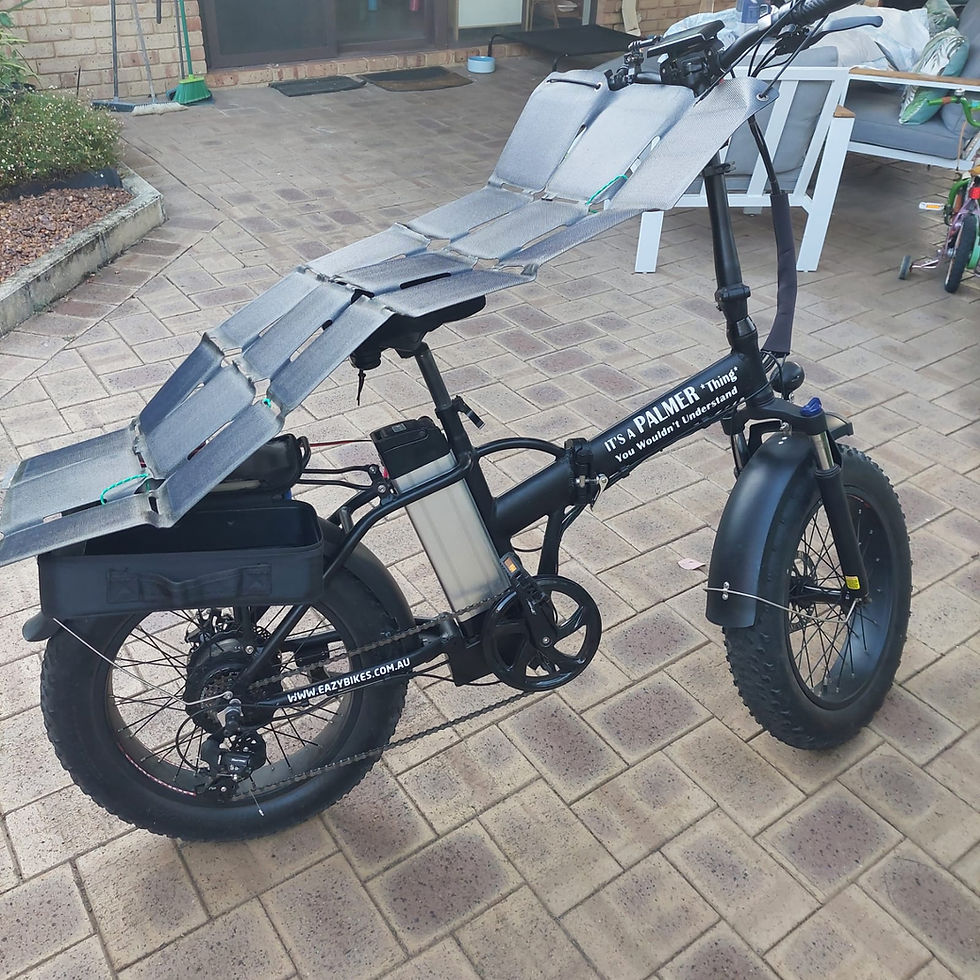
Shading the battery — An unexpected benefit discovered by Ken Lew, one of our Trial 1 riders: [the Solar eBike Cover] panels shade the battery from direct sun, reducing heat exposure during long stationary sessions. On a hot Australian beach, battery cooling is a genuine benefit.
Output on overcast days — Cloud cover reduces solar output. On a partly cloudy day, charging continues at reduced wattage. On a consistently heavy overcast day, output may be minimal — plan accordingly and top up via a grid charge if the forecast shows persistent cloud.
The top-up approach — Solar charging at the fishing spot works best with the [top-up philosophy]: ride out with a reasonably charged battery, fish and charge for two to three hours, ride back with more charge than you arrived with. It's not a fill-up system. It's a range-extension system — and for eBike fishing, that's exactly what's needed.
The eBike Fishing Setup — What You Need
A practical eBike fishing kit:
Fat tyre eBike — 4" tyres minimum for soft sand · ensure your eBike is road-legal in your region · rear rack as standard
Rod holder — Rear rack mounted, carries your rods securely
Tackle storage — Waterproof panniers or a dedicated tackle bag that mounts to the rack
Solar eBike Cover — Deploys at the fishing spot, charges while you fish, folds back to a carry case for the return ride
Fresh water bottle — For rinsing salt and sand off the bike after beach riding
Tyre pump — For adjusting pressure beach-to-road and back
Try It for Yourself
Trial 2 of the Solar eBike Cover is open to Australian riders. If you fish from remote beaches, estuaries, or coastal national parks — and you've ever cut a session short because of battery anxiety — this is the solution.
👉 Apply at solev.com.au 👉 Full product details at solarebikecover.com
🇦🇺 Australian owned & designed · As seen at Eurobike 2025 · Patent pending
References
[1] Solar eBike Cover output — 175–235W via SunPower cells in full Australian sun. Actual charging time depends on battery size and solar conditions. solarebikecover.com
[2] Bureau of Meteorology — Average daily solar exposure, Australia. bom.gov.au/climate/maps/averages/solar-exposure/
[3] Fat tyre eBike fishing guide — marsantsx.com/blogs/article/beach-fishing-fat-tire-ebike-guide
[4] eBike fishing access guide — vetanya.com/blogs/news/your-complete-guide-to-electric-bikes-for-fishing

Comments