


The World Is Getting Hotter — Here's How eBike Riders Can Be Part of the Solution
Environment & Clean Energy · solarebikecover.com

You've felt it. The summer that was hotter than last summer. The trail that was closed for fire danger when you planned to ride it. The heat that made a morning ride feel like an afternoon one.
This isn't bad luck. It's a pattern — and it's accelerating.
June 2026 was the hottest June ever recorded for western Europe and the second warmest globally [4]. Starting in late May 2026, temperatures across Europe ran 10 to 15 degrees Celsius above normal, breaking all-time records across France, the UK, Ireland, Spain and Germany [5]. Wildfires followed immediately. A monster wildfire swept from France's Bordeaux region into western Madrid, burning nearly 104,000 acres in France and around 190,000 acres in Spain — forcing more than 300,000 people to evacuate [7]. Droughts continued. In 2025, scientists estimated that around 16,500 people died as a result of climate change during the European summer alone [6].
These aren't distant statistics. They're the conditions that determine where you can ride, when you can ride, and what the places you ride in will look like in ten years.
The outdoor rider has more skin in this game than almost anyone.
The Connection Most Riders Miss
The link between climate change and outdoor recreation is direct and personal. Trails disappear under fire. Rivers run lower. Snow seasons shorten. The remote wilderness that defines the best riding becomes harder to access as extreme weather events multiply.
But there's another connection — less obvious, more actionable — that most riders haven't made yet.
The energy you use to power your rides contributes to the same system that's driving those changes. Grid electricity in many countries is still heavily fossil-fuel dependent. Petrol generators — the traditional off-grid charging solution — emit approximately 900–1,200g of CO₂ per kilowatt-hour [1]. That's worse than coal-fired grid electricity.
The eBike replaced the petrol bike or the car trip. It was the right move. But if the energy that charges the eBike comes from a generator in the bush or a coal-heavy grid at home, the emissions reduction is partial — not complete.
Solar charging in the field is where the loop closes.
What Solar Charging Actually Changes
Solar panels generate electricity at approximately 41–50g of CO₂ per kilowatt-hour over their entire lifetime — including manufacturing, transport, and installation [2]. That's roughly 20 times less than coal and significantly less than a petrol generator running in the field.
In practical terms: every charge from solar rather than a generator is a charge that didn't burn petrol, didn't emit carbon, and didn't add to the atmospheric loading that's driving the heat waves you're reading about.
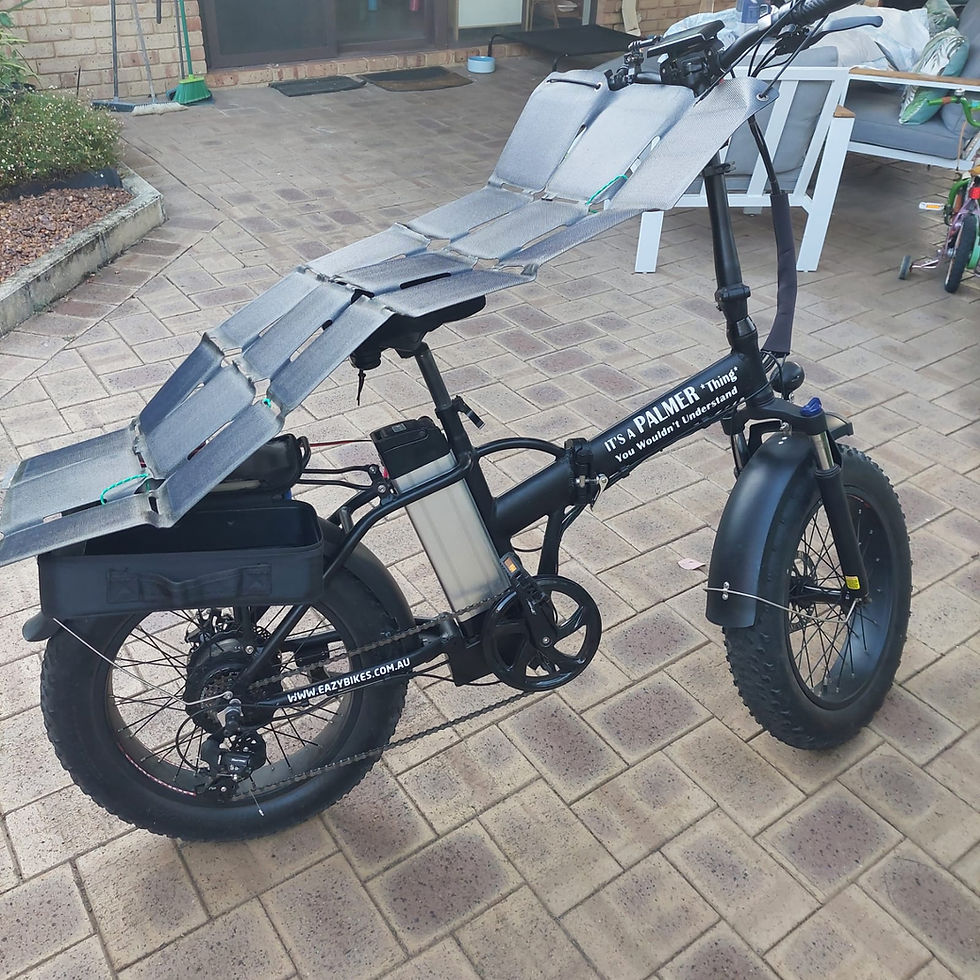
The Solar eBike Cover deploys at your location — not back at the grid, not at a campsite generator — and generates power from sunlight while you ride, fish, camp, or rest. The energy is local, immediate, and clean.
It doesn't solve climate change. But it closes the emissions gap in the specific context where most off-grid eBike riders have been leaving it open.
The Outdoor Ethic Already Points Here
There's a long tradition in outdoor recreation of caring about the places you visit. Leave no trace. Pack out what you pack in. Minimise your impact on the environment you're there to enjoy.
That ethic has always been about physical impact — waste, noise, disturbance. It's increasingly also about energy. The question of what powers a trip in the field is part of the same conversation as the question of what you leave behind.
Riders who carry solar rather than a generator are making a choice that aligns with the outdoor ethic in a new dimension. The spots they ride in — the remote beaches, the high country, the outback prospecting sites — stay cleaner not just from what they carry out, but from what they don't burn.
Three Riders Who Already Made This Choice
SOLEV's Trial 1 put the Solar eBike Cover in the hands of three Australian riders in exactly the conditions where off-grid charging matters most.
[Steven Palmer] — a gold prospector from The Vines WA — charged two eBikes completely off-grid for ten days in outback WA. No generator. No fuel. Just the Western Australian sun.
[Robert Hunter] — a hunter from Rocky Camp SA — tested the system ahead of a week-long expedition in the Victorian High Country. Dual batteries, remote mountain terrain, no power access.
[Ken Lew] — an eTrike rider from Seaford SA — discovered an unexpected bonus: the panels shading his battery from the South Australian summer heat, protecting the cells while generating clean power.
Three different riders. Three different use cases. Zero generators. Zero fuel burned at the charge point.
The Regulatory Direction Is Already Set
California has already moved. AB-1346, signed in 2021, bans the sale of new small petrol generators under 25 horsepower from 2028 [3]. The reasoning is straightforward: portable generators are a significant source of air pollution and carbon emissions in recreational and residential settings. Solar is the clean alternative.
Other jurisdictions will follow. The direction of travel is clear — and it's the same direction that outdoor riders who care about the places they ride are already heading.
You Can't Ride a Closed Trail
The argument for solar charging isn't abstract. It's concrete and immediate.

Australians already know this from experience. The Black Summer of 2019–20 burned over 46 million acres, destroyed thousands of homes, and killed an estimated one billion animals [9]. The Victorian High Country — some of Australia's best eBike terrain — was devastated. The fires wiped $2.8 billion from Australia's tourism supply chains [10], including the trails, campgrounds, and wilderness areas that outdoor riders depend on. Many didn't fully reopen for seasons.
Now it's happening in Europe. Wildfires burned over 172,000 hectares across Spain and France in 2026 — more than six times the amount that burned in the same period the year before [8]. The pine forests outside Bordeaux. The mountains of Madrid. Places where cyclists and outdoor riders have gone for generations.
The hotter summers get, the more fire danger closures there are. The more droughts intensify, the more rivers and trails are affected. The more extreme heat events multiply, the shorter the comfortable riding season becomes.
The riders who care most about protecting those trails and those conditions are the ones with the most reason to close the emissions loop on their rides. Solar charging in the field is one way to do that — practical, immediate, and available now.
The world is getting hotter. The places worth riding are worth protecting. And the energy choices made in the field are part of how that protection happens, one ride at a time.
Be Part of the Solution
The Solar eBike Cover is designed for riders who go where the grid doesn't reach — and who want to get there cleanly.
👉 Full product details at solarebikecover.com 👉 Join the waitlist at solev.com.au
🇦🇺 Australian owned & designed · As seen at Eurobike 2025 · Patent pending
References
[1] Petrol generator CO₂ emissions per kWh — natureoffice.com/en/co2-balancing/comparison-of-the-co2-balance-renewable-energies-vs-fossil-fuel/
[2] Solar panel lifecycle CO₂ per kWh (IPCC) — solar.com/learn/what-is-the-carbon-footprint-of-solar-panels/
[3] California AB-1346 generator ban from 2028 — ww2.arb.ca.gov/resources/documents/california-state-emergency-january-7-2025-sale-offer-sale-and-importation-u-s
[4] Copernicus — June 2026 hottest June on record for western Europe — climate.copernicus.eu/copernicus-record-heatwave-brings-hottest-june-western-europe-during-second-warmest-june-globally
[5] 2026 European heatwaves — Wikipedia — en.wikipedia.org/wiki/2026_European_heatwaves
[6] 2025 European heatwaves — estimated 16,500 deaths — en.wikipedia.org/wiki/2025_European_heatwaves
[7] France Spain wildfires 2026 — 300,000 evacuations — cnbc.com/2026/07/27/wildfires-spain-france-bordeaux-heatwave.html
[8] France Spain wildfires 172,000 hectares — irishtimes.com/world/europe/2026/07/27/france-spain-wildfires-latest-updates/
[9] Australia Black Summer 2019–20 — 46 million acres burned — ebsco.com/research-starters/history/2019-20-australian-bushfire-season-black-summer
[10] Black Summer — $2.8 billion tourism loss — sydney.edu.au/news-opinion/news/2024/01/31/black-summer-bushfires-australia-wiped-billions-from-tourism-supply-chains.html

Comments